
Here you will find answers to the questions we hear most often about watch straps, all in one place. Our guides go into detail, with pictures and videos. You will find the straps themselves among our watch straps.
Questions about watch straps
As a rule, changing a strap is not difficult. In the video below we show you how to do it yourself. You will find a detailed guide here: how to change a watch strap.
On a strap with a pin buckle, you adjust the size with the holes that are already punched. The pin of the buckle goes through the hole that fits your wrist. A deployment clasp gives you more ways to adjust. The videos below show how to adjust the folding clasp and the butterfly clasp. For the safety folding clasp there is an illustrated guide. Follow the links to learn more about each clasp.
The lug width is measured between the lugs of the watch. A calliper, digital or mechanical, is the most precise. A ruler or another tool marked in millimetres also works, but less precisely. The picture shows the measurement on the watch, in this example the lug width is 20 mm. You will find more in our guide how to measure the lug width and length.

The fitting is the part of the strap that is attached to the watch. Its width is called the lug width or strap width. You need this measurement to buy a new strap. It is given in millimetres (mm).
On a metal bracelet, the fitting is the end link between the watch and the bracelet. These end links can usually be removed and come off when you take the bracelet off.

It is the width of the strap at the buckle. You need this measurement if you want to replace the buckle. It is measured in millimetres (mm), see the picture. You will find replacement buckles among our single buckles.

The length depends on the diameter of the watch, your wrist size and whether you like to wear the strap loose or tight. Our guide how to measure the length of a watch strap explains how to measure your wrist and the other lengths.

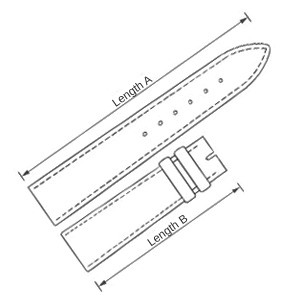
Measure both parts of the strap, the part with the holes and the part with the buckle, and add the values together. This gives you the total length. If you measured the strap together with the watch case, subtract the diameter of the case afterwards. The lengths A and B of each strap are in the table in the item description. You will find more in our guide.
The strap can be changed on almost every watch. It all depends on how it is attached to the watch. If the strap is held by a spring bar and the fitting is straight, you will easily find a replacement strap. If your watch has fixed bars, so no removable spring bars, you need a strap for fixed bars. These straps usually have a clip or open ends that are glued. On watches with a special fitting, usually only a strap made for that model fits, but it can still be changed. As changing the strap differs a lot from brand to brand, we cannot describe it for every watch.
As a rule, a leather watch strap is not shortened. The edges and ends are often sealed with a lacquer that would be damaged. Straps with folded edges cannot be shortened either, because the top leather is folded around the sides and stitched underneath. The stitching must not be damaged, or the strap comes apart. A leather craftsman or a cobbler could shorten it properly.
The price depends on the material and the workmanship. Across the market it ranges from around 15 euros to several hundred euros. A strap made of genuine alligator leather costs considerably more than one made of cowhide, because the skins are expensive. The buckle also matters: a pin buckle costs less than a deployment clasp, because it is simpler to make.
Questions about leather watch straps
Moisture is the worst enemy of leather, so keep the strap away from water. If it does get wet, let it dry slowly in a dry, well-ventilated place. Direct sun and strong heat damage the leather.

Take turns with a second strap regularly. This gives the leather time to dry, and it is not in constant contact with your skin. Take the watch off for sport: leather absorbs sweat, and its breakdown causes smells.

That depends a lot on how it is used: from a few months to several years. For a leather strap, how often you wear it, water, moisture and sweat matter most. Take the strap off when you shower, bathe or sweat, and it will last noticeably longer. More tips here: how long does a watch strap last and how do you care for it?

To emboss leather, a pattern is pressed into smooth leather with a roller or a plate, under pressure and heat. The natural grain of the leather almost disappears. The temperature is between 45 and 90 °C, and the pressure can reach 350 kg. The right values depend on the material. Newer methods engrave patterns or lettering with a laser, but they do not allow deep embossing.
Almost any pattern is possible. One example is crocodile embossing: it gives cowhide the look of real crocodile leather, often so realistic that it is easy to mistake. Embossed leather costs considerably less than genuine Louisiana alligator.
Small motifs such as logos or lettering are embossed with a stamp, by hand or by machine. The metal plate that carries the motif in reverse is called a die.


Clean the strap regularly with a soft, slightly damp cloth, without pressing hard, or the leather will suffer. A leather grease that is gentle on the skin keeps the strap supple, loosens dirt and stops it from getting into the pores. Step-by-step instructions are in our guide cleaning and caring for a leather strap.
For the top, use a leather care product that is gentle on the skin and free of harsh chemicals. It is better not to treat the underside, as it is in direct contact with the skin. Do not care for the strap too often, every 3 to 4 months is usually enough. A break of 2 to 3 days also does the leather good.
Unprocessed pieces of leather are called raw hides. They often still have the shape of the animal. Scars and flaws are usually cut out, which creates a lot of offcuts in production. Embossing can also hide these spots, which saves material. Hides intended for embossing are often sanded on the grain side, so that the leather has the same thickness everywhere and is easier to work.